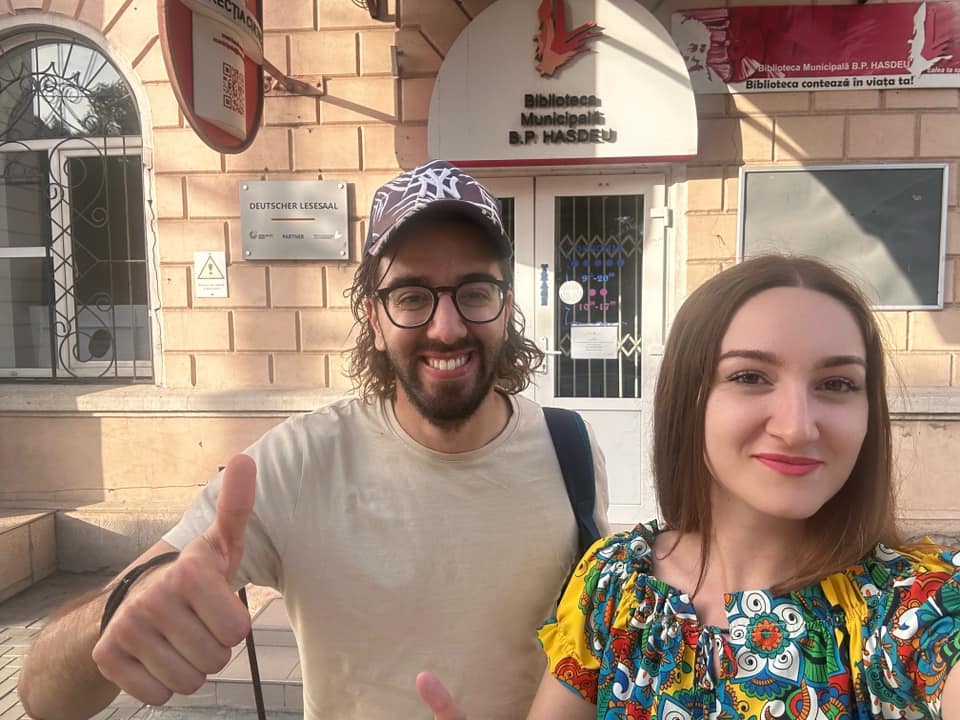
Adlen: “The bus conductor from Chisinau reminded me of my parents’ home country in North Africa”
Interview with Adlen, tourist from France
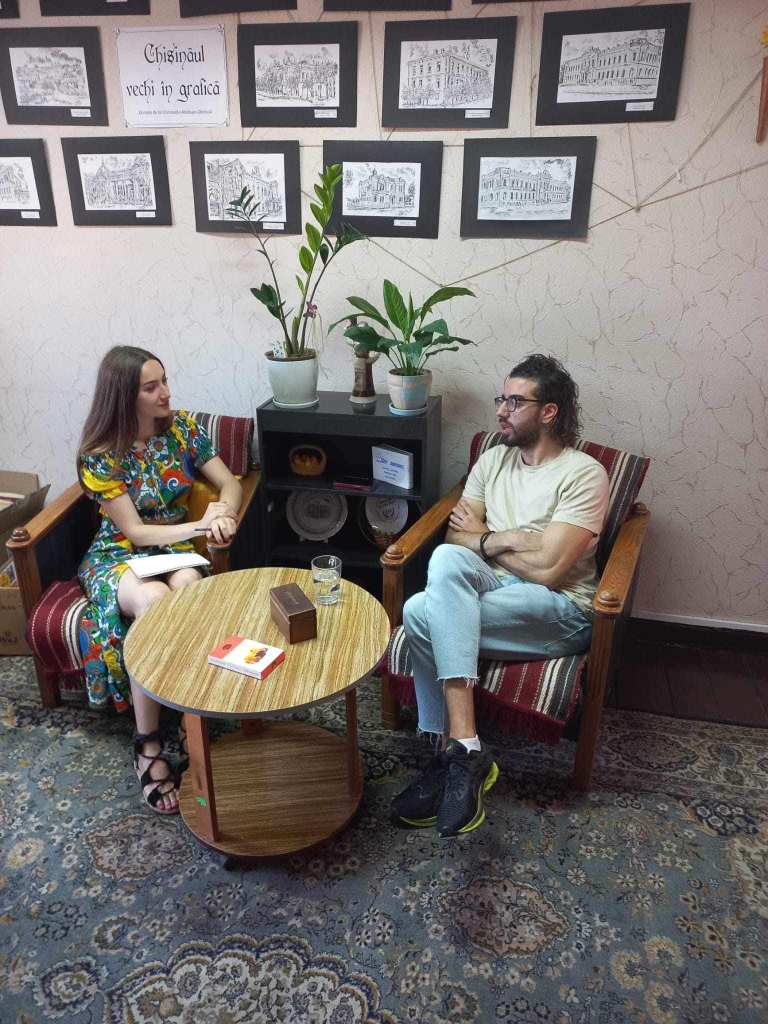
My name is Adlen and I am 32 years old. I come from Grenoble, a city in the south-east of France. My parents are from North Africa and emigrated to France. I graduated from the Faculty of Finance and Accounting, but I’ve changed to International Relations and I did a Master’s in Geopolitics. I love geopolitics, history, geography. When I go into a museum, I can stay there for more than an hour. I worked in a humanitarian organisation in Paris. Now I work in an organisation specialised in education that fights social and educational inequalities.
I came to the Republic of Moldova for 8 days to discover Chisinau and Tiraspol. Being passionate in history, I wanted to discover the atmosphere of post-soviet cities, so I ended up here.
What was your first impression about Chisinau?
This is my first time in Chisinau. I was pleasantly surprised when I arrived here, because I didn’t have high expectations about what I was going to see. I got out of the airport, got on the trolley bus 30 and arrived in the center of the capital, where I rented an apartment.
The center is so beautiful at night. The streets are well-lit, and in the evenings the city is animated with Chisinau residents who spend their time walking in the park and eating ice cream or enjoying a refreshing drink in a restaurant. From what I saw, I can say that Chisinau is much more animated than Riga, a city I visited in the past. Perhaps I wouldn’t have said the same if I had lived in an apartment further away from the city center.
I was most impressed by the public transport. When I first got on the trolley, I realized that there is a person in the transport that gives tickets for the trip, and also a terminal where you can pay with your card. It’s an antithesis that somehow represents Chisinau, a city in transition from post-Soviet to Western. And the person who gives tickets reminded me of my parents’ home country in North Africa, a less developed place. You don’t find such things in France.
What cities can you compare with Chisinau?
If we’re talking about size, Chisinau is similar to my city, Grenoble. In terms of its looks, I think Chisinau is a mix of Soviet and European cities. This city reminds me a lot of the suburbs of Riga, namely the old buildings you can see everywhere in Chisinau. However I also feel the Mediterranean atmosphere here, not only because of the climate, but also the way the city is “designed” and in this sense we can compare it to Southern Spain or Italy. On the other hand, the people are totally different.
What did you like the most in Chisinau?
One of the things I liked the most is public transport. Coming here from abroad and not having a car, I find it extremely convenient to get from one point to another in the city by public transport. The fare is very cheap and you can get anywhere you want in Chisinau even with one trolley bus. Public transport is a good thing and I think it should exist in all capitals. It is very strange when I visit cities that are very developed but do not have public transport.
Another strong point I noticed and admire are the clean streets in Chisinau. In general, travelling a lot, I understand that in post-communist countries, such as the Czech Republic, Latvia, cleanliness is highly respected. I don’t think it’s because of the fines they can get if they throw rubbish on the road, but it’s the mentality of the inhabitants who are used to keep cleanliness in public places. And if you come to a city of people who respect the environment and cleanliness, as a tourist you will keep that used package with you until you find a bin. In my city it is not as clean as here in Chisinau.
I also like the traffic lights here. They impress me by showing you how many seconds you have left to cross the street. In France you have to run as fast as you can to avoid running red lights. And some of the traffic lights also have a voice warning for those who are blind. It’s a well designed city for people with disabilities.
You talked about the things that impressed you, but what did you NOT like in Chisinau?
I will tell my own impressions. Maybe I’m wrong, but I found the people here quite cold, they smile too little. In the city I come from, the people are very communicative and always smiling. It’s part of the culture and reflects the mentality of the inhabitants of a city or a country.
Another thing I have noticed in this respect is that people here care too much about how they look, especially women. The exaggerated concern for physical appearance shows, to me, a lot of superficiality. That’s just my opinion and I don’t raise it to the level of a rule. Being a foreigner in Chisinau, due to the lack of time and the language barrier, I cannot communicate much with the locals, and this fact does not allow me to discover in detail the true nature of a Chisinau citizen.
What are your impressions of the local population?
Talking about the language barrier, in Chisinau you can meet many people who know English. For comparison, in Tiraspol none of the people I interacted with knew English. In such cases, the Google translator app can help a lot, or in exceptional cases, we speak with hand signs. What I found interesting was that people react differently to the language barrier. I met people who, seeing that I didn’t speak their language, showed no interest in helping me. Others, especially young people, treated it as a challenge and tried to figure out how they could talk to me.
At the same time, it seems to me that the gender ratio in Moldova, women and men, is not equal. Latvia is the country where the difference in this sex ratio is the largest – 85 men for every 100 women. I think that Moldova is not far off in this respect. I saw a lot more women around the city than men. Probably one of the reasons is that many men go abroad to work, and emigration is very much promoted here. Everywhere I see posters and advertising material announcing new jobs available for Moldovans in other countries.
What stereotypes about Moldovans are widespread in France?
One of the stereotypes is that people in Moldova, but also in other ex-Soviet countries, are still influenced by pro-communist propaganda and still think about the past. Another thing known in France about the Republic of Moldova is the large number of Roma living here. The French don’t like the Roma because they think they are often involved in various law-breaking cases and when they are detained by the police, they say they come from Romania, Moldova or Ukraine.
I realise that all these stereotypes do not reflect the truth about the Republic of Moldova, that they are just a few cases which distort the image of a country’s population.
What is your favourite building in Chisinau?
I really like the building of the National History Museum. It is very imposing, and the Museum’s garden is well arranged and pleasing to the eye.
Would you live in Chisinau?
Yes, definitely. I have had the opportunity to live in cities less beautiful than Chisinau. The biggest problem would be the language barrier, but I think I could learn Romanian or Russian. For me this is very important, because I like to communicate with people. Otherwise, I think I would be happy to live in Chisinau, given the relatively low cost of living, the abundance of cultural attractions, the beauty and quiet of the parks.
If you could change anything in Chisinau, what would you do?
In my city of Grenoble there is a lot of cycling, i.e. we have bicycle paths all over the city. Grenoble is the city with the most kilometres of bicycle paths in France and is known in Europe for this ecological achievement. Almost all my work colleagues cycle and the car is only taken out of the garage if really necessary. In Chisinau, I have not seen many people cycling, nor the necessary infrastructure. Cycling means a healthy life style, environmentally friendly and, of course, less traffic jams.
 Chișinău, orașul meu